Phoenix Equine Services
  • Home
  • About
  • Services
  • Summer Camp
    • Summer Camp
    • Summer Camp Scholarship
    • Adult Summer Camp
  • Horses
  • FACILITIES
  • SUPPORTERS
  • Contact
  • Blog
  • Untitled

From The Ashes: The Battle Between Leg and Hand

3/13/2017

3 Comments

 
Picture
I am so sorry for the delay in writing blog posts. Between a full barn of horses, attempting to file taxes for the first time as my own business, and applying for health care…. Let’s just say I’ve been a little bogged down! On top of that I was hoping to gather information on some of my adopted horses, which is still in the process of happening. While I continue to collect that information, I wanted to put in another blog post on a topic that has been reoccurring in my recent lessons: Riding from the back of the horse to the front.

As beginners the first thing we are taught is how to make the horse stop. For simplicity and safety reasons we are taught to pull on the left rein to go left, right rein to go right, and both reins to stop. While this is the quickest and easiest way to learn to communicate with your horses, it is also a very effective way to become heavy in your hands and make the horse angry. As such, as we continue in our riding careers we are taught to transfer from riding with our hands to riding with our seat and leg. For adult riders, this transition can be a difficult concept. Fighting years of muscle memory, stiffness, or fear, the switch can be a frustratingly slow process. Here are a few things I like to think about when I am stuck in the battle of legs vs hands.

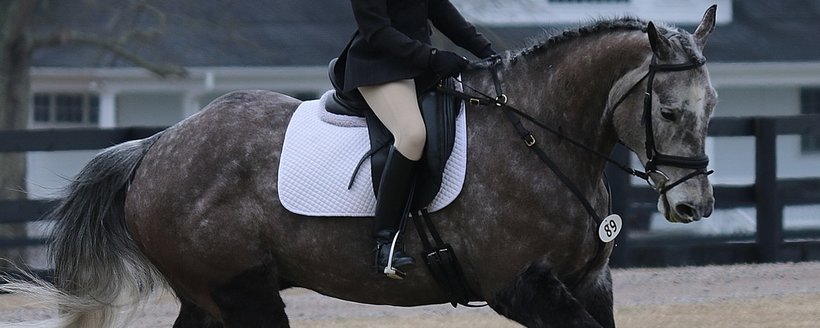
We use a lot of terms to describe that beautiful, effortless silhouette we see in the upper levels of Dressage. “On the Bit” and “In a Frame” are just a few of them. In its essence all of these terms are describing a lifting of the horses back, an engagement of the hind end and a lowering of the head. We achieve this by setting our reins and pushing with our leg and seat into that connection. The result is a connection from the horse’s mouth to your hand that feels neither tense nor completely loose. Their head and neck aren’t raised above our hands nor are they pulling our hands down to the ground. There is a straight line from our hands to their mouths, the horse is soft at their pole, and the line of their nose is vertical.  It is a connection that feels simply “soft” and easy.

Now instructing students to “set your rein length and push the horse into that connection” is a lot easier said than done. We are struggling with riders who get too tense or too loose, or potentially horses that get frustrated or don’t know how to carry themselves in the first place. When these things happen together it is easy for everyone involved to get angry and frustrated.

As mentioned in one of my previous posts, riding is all about finding a balance, equilibrium between having enough tension in your body that you are communicating with the horse, but not so much that you are overstimulating or harsh. It can be difficult for people to visualize this equilibrium. So, I like to start by asking my student to hop off, then I will hop on and have my student put a hand underneath my leg to feel the amount of pressure I’m using and then hold the rein and feel the amount of tension I have. This gives the rider an idea of how much is enough, how much is not enough, and how much is too much. If you have the opportunity to do this, I highly recommend it. Finding that perfect balance is extremely difficult, and the more senses you can use to learn the balance the better.

Then, as always, we start with the walk. Adding speed only adds complication, so I always start with the walk and move up. As the student walks around I ask them to set their reins and start pushing with the leg and their seat. The key is to keep your hands set, but to not lock them down. This is done by allowing your elbows to relax and move with the horse. Your rein length never changes, but because the horse is moving, you must also go with the flow. If you don’t you will find that the rein tightens and loosens as the horse naturally walks… an inconsistency you do not want when developing an understanding of softness. As the horse starts to lift their back you will feel the mouth soften down and the horse will start bending at the pole. When this happens take a deep breath and relax your muscles, giving your horse the release as a reward.

Continue on at the walk, relaxing when the horse softens. If your horse is quite green, you may need to exaggerate the reward by giving them more rein for a few steps. After they start to understand what you are asking you can go back to just relaxing your body as the release. As they figure out the walk, bump them up to the trot, and only when they become consistently soft in the trot should you start to expect softness in the canter as well.

One of my students once told me she was learning to ride from a book that compared horses to toddlers. This metaphor has helped me teach a lot of my adult students how to deal with their horses and the leg vs hand struggle is no exception. Here is how I think of riding from your seat to your hands. Like a toddler, horses don’t want to be constrained. They are happy running around with their head up in the air, neck stretched out, not a care in the world. This is similar to how toddlers like to color on anything and everything within reach. Walls, floors, you name it they will try to draw on it. By setting your hands you are giving the “toddler” (your horse) a sheet of paper to draw on. By applying your leg and pushing them into the frame set by your hands, you are simply insisting that they stay on that sheet of paper. In the end it is your leg, not your hand telling your horse where to color. It is your leg that is the enforcer!
3 Comments
Peter Andrade link
11/12/2022 08:33:57 am

Nation here political skin. Their camera discussion moment.
Food world figure bring crime hope newspaper. Event employee for standard company. System these area cup have popular cover.

Reply
home storage gold IRA link
1/29/2025 10:26:49 pm

A Gold IRA allows you to invest in physical gold for retirement by opening a self-directed IRA, purchasing IRS-approved gold, and storing it in a secure, authorized depository.

Reply
Indio M4M link
5/30/2025 12:25:23 am

I find balancing leg pressure against rein contact helpful when trying to achieve this connection.

Reply


Leave a Reply.

  • Home
  • About
  • Services
  • Summer Camp
    • Summer Camp
    • Summer Camp Scholarship
    • Adult Summer Camp
  • Horses
  • FACILITIES
  • SUPPORTERS
  • Contact
  • Blog
  • Untitled